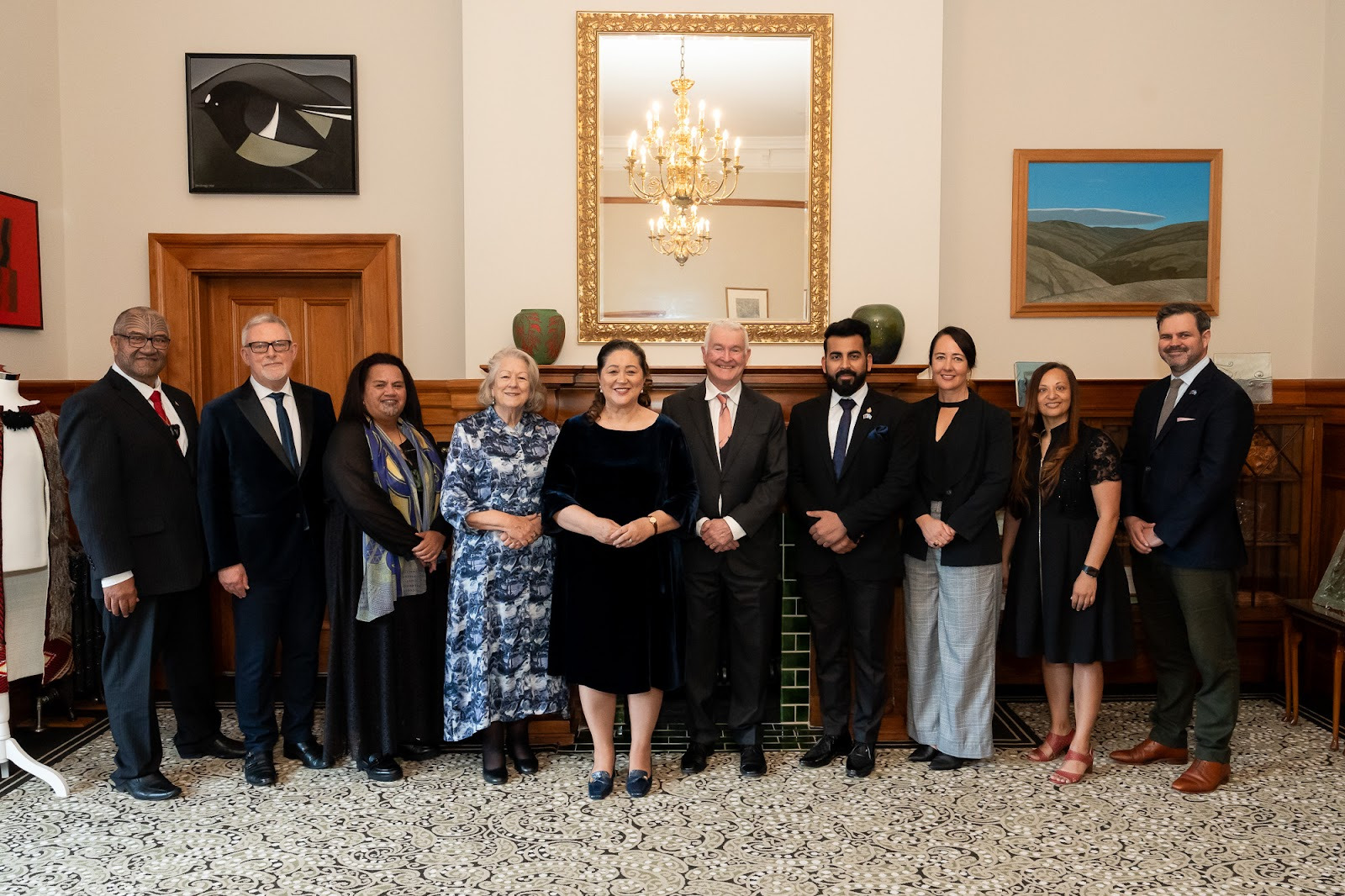
On Friday 31, October 2025 the United Nations Association of New Zealand (UNANZ) sponsored a reception commemorating the 80th anniversary of the United Nations.
That night, James Bushell, President of UNANZ, reminded us of what truly matters. Here is the main body of his speech:

Tonight, we celebrate 80 years of an idea that refuses to give up on humanity. The United Nations put into words an aspiration, a world where peace, dignity, and equality are enjoyed by all on a healthy planet.
That vision resonates deeply in Aotearoa, where kaitiakitanga calls us to be stewards of the natural world, and manaakitanga asks us to extend care and respect to one another.
Since the UN’s beginnings, by many measures, the world has made extraordinary strides. As the scholar Steven Pinker and others have shown, our era has seen unprecedented declines in conflict and improvements in human wellbeing.
No single institution can claim that victory, but multilateralism has provided the forum, the rules and the habits of cooperation that push the arc toward peace.
This progress didn’t happen by accident, it was worked on, it was negotiated.
I love the concept of Thomas Hobbes the Leviathan. He uses the metaphor of the mighty sea monster, perhaps in Aotearoa we could think of this as our taniwha, to represent a system powerful enough to prevent society from slipping into anarchy. This power is a social contract held to account by society's integrity systems, the laws, institutions, watchdogs and civic norms that keep power transparent, accountable and fair.
We might imagine the UN as our taniwha, powerful, sometimes fearsome, occasionally frustrating but ultimately a guardian of balance in dangerous waters. In the absence of that guardian, we drift toward might makes right, toward zero sum geopolitics, toward a world where the vulnerable pay the highest price.
Strengthening the UN is Essential
Guardians need integrity and support and ours (the United Nations) is currently under strain. We are witnessing the erosion of our integrity systems, funding cuts that prevent us from resourcing our collective response effectively, disinformation corroding trust, polarisation hardening discourse, and impatience with rules when they constrain immediate interests.
In recent years, we have also witnessed a shifting world order, an increasing multipolar landscape, rising strategic competition and conflict and new technologies that transcend borders and outpace regulation. Add to this the planetary stressors, neighbouring communities losing their homes to sea level rise, farmers grappling with climate extremes and biodiversity loss and fragile states hit hardest from crises they did little to cause.
No country, however large or resourceful, can solve these alone. Without cooperation, we face the tragedy of the commons where acting in our own national interests, depletes our shared and finite resources, resulting in free riding, short termism and cascading harms.
This is why strengthening the UN is not optional, it’s existential.
The UN today
So let’s speak plainly about the UN we actually have.
The United Nations is imperfect. At times it lacks the authority or the political will to act. The Security Council veto can paralyse collective action, and still privileges the power dynamics of 1945. And yet, it is the best institution we have for global legitimacy, coordination, standard-setting, and accountability.
If we didn’t have the UN, we’d have to invent it under far worse conditions.
Now, more than ever we must support and strengthen the UN. That means resourcing its mandates, defending its independence, and backing reforms that make it fit for purpose in the 21st century. Rebuilding integrity is not a slogan, it’s a practice, transparent institutions, evidence-based policy and strong civic education.
We know that the UN system can work.
Consider the Universal Declaration of Human Rights not a treaty with tanks behind it, but a moral north star that has shaped constitutions and reframed what people everywhere can expect from power.
New Zealand's Record
Consider New Zealand’s own record:
After the Rainbow Warrior, we used international law and diplomacy to uphold accountability while preserving relationships in a volatile moment. These weren’t acts of naïveté; they were expressions of strategic realism that rules and forums amplify a small nation’s voice.
So what can we all do from here, from the United Nations Association of New Zealand, right now?
- First, champion UN reform that enhances legitimacy and effectiveness.
- Second, double down on international law and human rights mechanisms. They are the shield of small states and the voice of the voiceless.
- Third, lead where Aotearoa is strong: Transparency and integrity systems, climate action and oceans governance, Pacific partnerships, and integrating Indigenous knowledge and kaitiakitanga into global solutions.
- Fourth, invest in diplomacy, youth engagement and education to build pathways that cultivate the next generation of multilateral leaders.
Our Mandate
This 80th anniversary is not just a milestone it’s a mandate. We honour the past by building the capacity to act in the present. We celebrate our achievements and confront our shortcomings.
Let me end where I began: We work so that peace, dignity, and equality are not the privileges of a few, but the birthright of all on a healthy planet. I have a young daughter, this is the kind of world I want for her. I think of your children and mokopuna and want the same for them. We are stewards, not simply beneficiaries, of the international order we inherited.
Kia kaha. Kia māia. Kia manawanui.
Tonight, let’s celebrate 80 years of the United Nations imperfect, indispensable, and ours to strengthen. May we recommit to our integrity, our diplomacy, and our collective courage to the next 80 years.
Ngā mihi nui.