

Across the Pacific, civil society continues to show that determined, principled action can shift power, strengthen democracy, and protect public resources.
As we acknowledge Anti-Corruption Day, we celebrate the remarkable contributions of Transparency International chapters across the region to this action. These organisations are building public accountability, nurturing informed citizens, and developing tools to challenge corruption in all its forms.
Transparency International Papua New Guinea: Organising Communities and Protecting Democracy
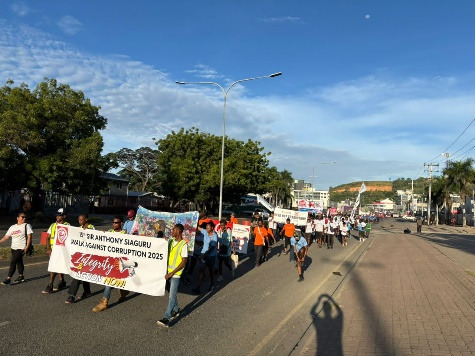
Transparency International PNG (TI PNG) has had a year marked by deep community engagement and national advocacy. In April, they facilitated the Community Coalition Against Corruption—now a vibrant alliance of more than 80 members from 50 organisations, including churches, youth groups, women’s networks, media, industry and trade unions. This coalition is giving communities the knowledge and voice they need to demand integrity and take action when corruption undermines their rights.
Young people remain at the centre of TI PNG’s vision for long-term change. Through the Youth Against Corruption Association (YACA), students meet, debate, and build civic confidence. The first-ever teachers’ workshop held in July strengthened educators’ capacity to nurture democratic values and integrity among PNG youth—planting seeds for future leadership.
TI PNG has also demonstrated its influence at the national level. Following persistent engagement, the PNG Government signed the UNCAC Transparency Pledge, committing to greater openness under the UN Convention Against Corruption.
The chapter continues to advocate for the independence of the Independent Commission Against Corruption (ICAC) and has publicly emphasised the need for political non-interference.
One of PNG’s most visible anti-corruption platforms, the Sir Anthony Siaguru Walk Against Corruption, marked its 15th year with a record 184 teams. This national event provides an essential public space for citizens to collectively stand against abuse of power.
Natural resource governance has remained a priority. As leader of the PNG Resource Governance Coalition, TI PNG advocates for reforms aligned with the Extractive Industries Transparency Initiative (EITI) to prevent the country from being grey-listed by the Financial Action Task Force. This work aligns closely with its planning for the 2027 general elections, where TI PNG is coordinating a Youth Elections Technical Working Group and promoting reforms to strengthen electoral integrity.
To enhance public accountability, TI PNG regularly publishes an Accountability Scorecard tracking which public entities have submitted financial statements for audit—an important tool for public scrutiny. It has also contributed expert submissions on journalism standards, the Right to Information framework, and anti-money laundering policies, and co-hosted PNG’s first AML conference with the Bank of PNG.
TI Australia: Building Regional Capacity

TI Australia plays a key role in strengthening integrity tools and know-how across the Asia-Pacific region. Its Integrity and Corruption Risk Assessment Tool (ICRAT), originally developed and applied in Indonesia and Solomon Islands, has now been scaled up to Sri Lanka and Pakistan, with country teams trained and assessments planned for late 2025. The findings will inform national reforms in 2026.
In August, the Asia-Pacific Integrity School in Melbourne brought together participants from Indonesia, Mongolia, Pakistan, Sri Lanka, Papua New Guinea, Vanuatu and Australia. The programme blended learning on social accountability, climate governance, and anti-money laundering, building a network of practitioners capable of confronting corruption challenges shared across borders.
Recognising the risks in evolving energy landscapes, TI Australia also developed community consultation guidelines for renewable energy and critical minerals projects. These guidelines help ensure that vulnerabilities from extractive industries are not replicated in the transition to low-carbon energy systems.
TI Vanuatu: Standing with Citizens
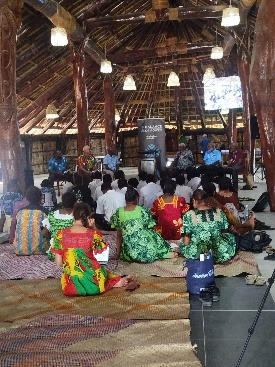
[[ Caption: TI Vanuatu civic education on right to information]]
TI Vanuatu has continued to strengthen civic knowledge and provide frontline support to citizens. Its Civic Education programmes help communities understand their rights and responsibilities, while its Advocacy and Legal Advice Centre offers professional legal support to individuals seeking guidance on corruption-related issues.
The chapter has invested heavily in partnerships, establishing working relationships with the Office of the Ombudsman, the Right to Information Office, the National Youth Council, NGOs, media, church leaders, and government ministries. Through these collaborations and its representation on many key national bodies, TI Vanuatu unites voices against corruption and shows how corruption affects development, the economy, fair elections, climate change and the lives of ordinary people.
Its advocacy has already produced tangible outcomes - improved reporting on MP allowances, restrictions on allowances entering personal accounts, and pressure to stop early releases of convicted criminals.
These reforms send a clear signal that accountability must apply to all.
Transparency Solomon Islands: Defending Communities and the Rule of Law
Transparency Solomon Islands has been outspoken on governance issues affecting the security and wellbeing of communities. The chapter has condemned ongoing issuance of logging permits that threaten endangered timber species in Isabel and Choiseul, and has conducted research into company ownership behind destructive mining operations in East Choiseul.
Its work highlights not only environmental harm but also failures in law enforcement and the need for stronger protection of landowners’ rights.
The chapter has also raised concerns about the frequent reshuffling of ministerial roles and has consistently called for political stability to ensure coherent governance. It continues to advocate for improved resourcing of the Solomon Islands Independent Commission Against Corruption (SIICAC) and amendments to strengthen the Anti-Corruption Act.
Youth engagement remains active through the Youth for Democracy Workshop, which this year equipped 30 young participants with a stronger understanding of their legal and constitutional rights.
Integrity Fiji: Rebuilding and Re-engaging
Integrity Fiji is in a period of revitalisation—rebuilding staff capacity, strengthening governance systems, and re-establishing external engagement.
With renewed focus on democratic development and high-level governance issues, the chapter is working toward regaining full accreditation within the Transparency International movement.
TI New Zealand: Connecting the Region
Transparency International New Zealand (TINZ) has played a crucial convening role, hosting nine cross-Pacific webinars exploring environmental governance, indigenous leadership, women’s political participation, and financial integrity—key issues that resonate across the region.
Focusing on New Zealand,TINZ coordinated a collaborative civil society submission to New Zealand’s UNCAC review and produced a national corruption scan to support evidence-based advocacy.
The chapter has also championed lobbying transparency in collaboration with partner organisations.
Six Public Sector Leaders Integrity Forums brought senior officials together to discuss ethical governance, while targeted advocacy focused on procurement standards and data ethics.
Across the Pacific, these chapters demonstrate that civil society remains one of the most powerful forces for accountability. Their work—rooted in communities, energised by youth, and driven by a commitment to justice—continues to strengthen democracy and build a future where integrity is the expectation, not the exception.


