

On 30 June 2026 the OECD released its annual report ‘Drivers of Trust in Public Institutions’.
What is the survey, and what are the global results?
The OECD Trust Survey explores people’s perceptions of different public institutions in their country and the degree to which they trust their government. These perceptions range from day-to-day interactions with public institutions to decision-making on complex policy issues. It showcases evidence on people’s experiences with and expectations of government reliability, responsiveness, fairness, integrity and openness.
The 2025 Survey was conducted in 38 countries. The NZ wave had 2,004 respondents, from 10 September- 5 November 2025.
Across all countries in the OECD report, fewer people report high or moderately high trust in the national government (40%) than low or no trust (43%). After a slight decline between 2021 and 2023, trust has stabilised on average, and slightly improved in about half of the countries where it previously declined. The public service, local government, police and courts continue to elicit higher trust levels than central government.
Do New Zealanders have trust in public institutions?
Overall, the picture for New Zealand is mixed. Trust in the public service and local government looks comparatively strong, but our country shows some of the largest trust gaps in the OECD - by political agency, education, discrimination status, and a widening one by gender and age. This suggests that trust is more unevenly distributed across different groups than in many peer countries.
In a very quick summary:
- More than two-thirds of people cited inflation as a top-three concern facing the country, well above the norm for most other countries.
- Trust in local government rose by more than two percentage points between 2021 and 2025, putting NZ in a group with Finland, Germany, Iceland, Ireland, Korea, Portugal, Spain, Sweden, Switzerland, the UK and Brazil.
- NZ is among the countries (with Australia, Ireland and Switzerland) where trust in the core national public service is at or above 60%.
- However, New Zealand stands out for one of the biggest "gaps" between trust in the public service itself and trust in central government: a 12-percentage-point gap favouring the public service. This is second only to Finland's 16-point gap.
- More than two-thirds of respondents (69%) across the OECD trust the central government when they believe people like them have a say in government decision-making, compared with only one-fifth (22%) among those who feel they do not have a say—a trust gap of 47 percentage points. The largest gaps are observed in Australia (60 percentage points), followed by New Zealand (58) and Denmark (57).
- There are education and discrimination-related trust gaps. The gap in trust between people with high versus low education levels is "substantially larger" in New Zealand than the OECD average (also true of Ireland and Sweden).
- New Zealand has the largest trust gap linked to discrimination experience among the countries studied: a 24-percentage-point gap between those who do and don't identify as part of a discriminated-against group.
- New Zealand stands out for a continuously widening gender gap in trust in Parliament, growing from 7 percentage points in 2021 to 21 points in 2025.
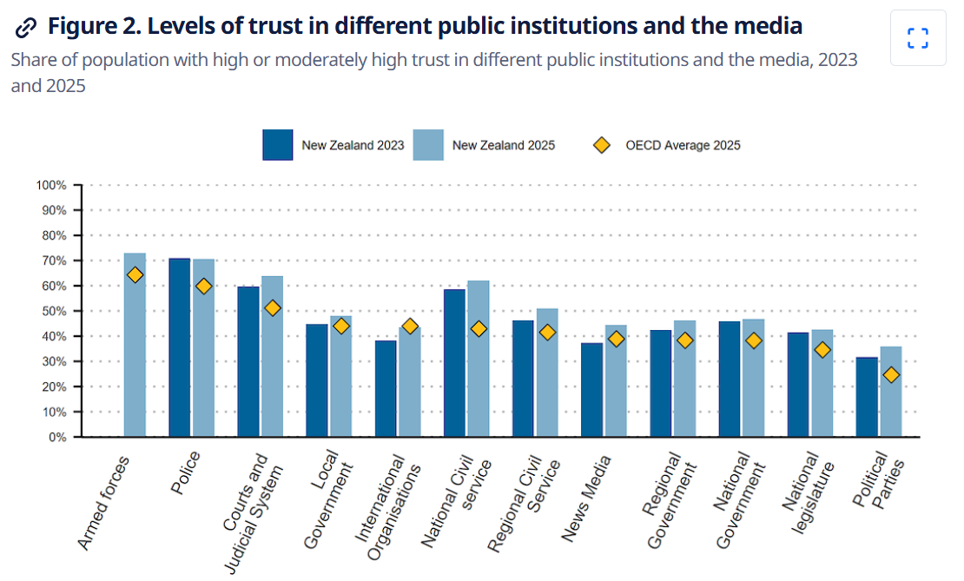
- Trust in public institutions in New Zealand varies across institutions and generally stands above the OECD averages for several political and administrative institutions. In 2025, 71% trusted the police, 64% the courts, 62% the public service (compared with the OECD average of 45%), while trust in political parties stood at 36%.
- Unlike most countries, where the age-related trust gap has narrowed since 2021, New Zealand is one of five countries (with Colombia, Denmark, Finland and Sweden) where the gap between younger and older respondents has widened.
- Satisfaction with education and health systems has been "consistently rising" in New Zealand from 2021 to 2025, alongside Australia, Canada and Sweden. Satisfaction with administrative services increased from 70% (2023) to 71% (2025), perceived fairness in benefit applications from 61% to 62%, and perceived legitimacy of public sector data use from 57% to 60%, indicating improvements in day-to-day experiences associated with higher trust.
- New Zealand is highlighted alongside Switzerland as a country where people are relatively confident elected representatives would respond meaningfully if contacted, even though relatively few people actually contact a politician.
There is more rich data in the full survey report, and some further highlights in the NZ short online report


