Wellington, 10 February 2026 — New Zealand’s declining Corruption Perceptions Index (CPI) score signals growing risks to the country’s democratic integrity and global reputation.
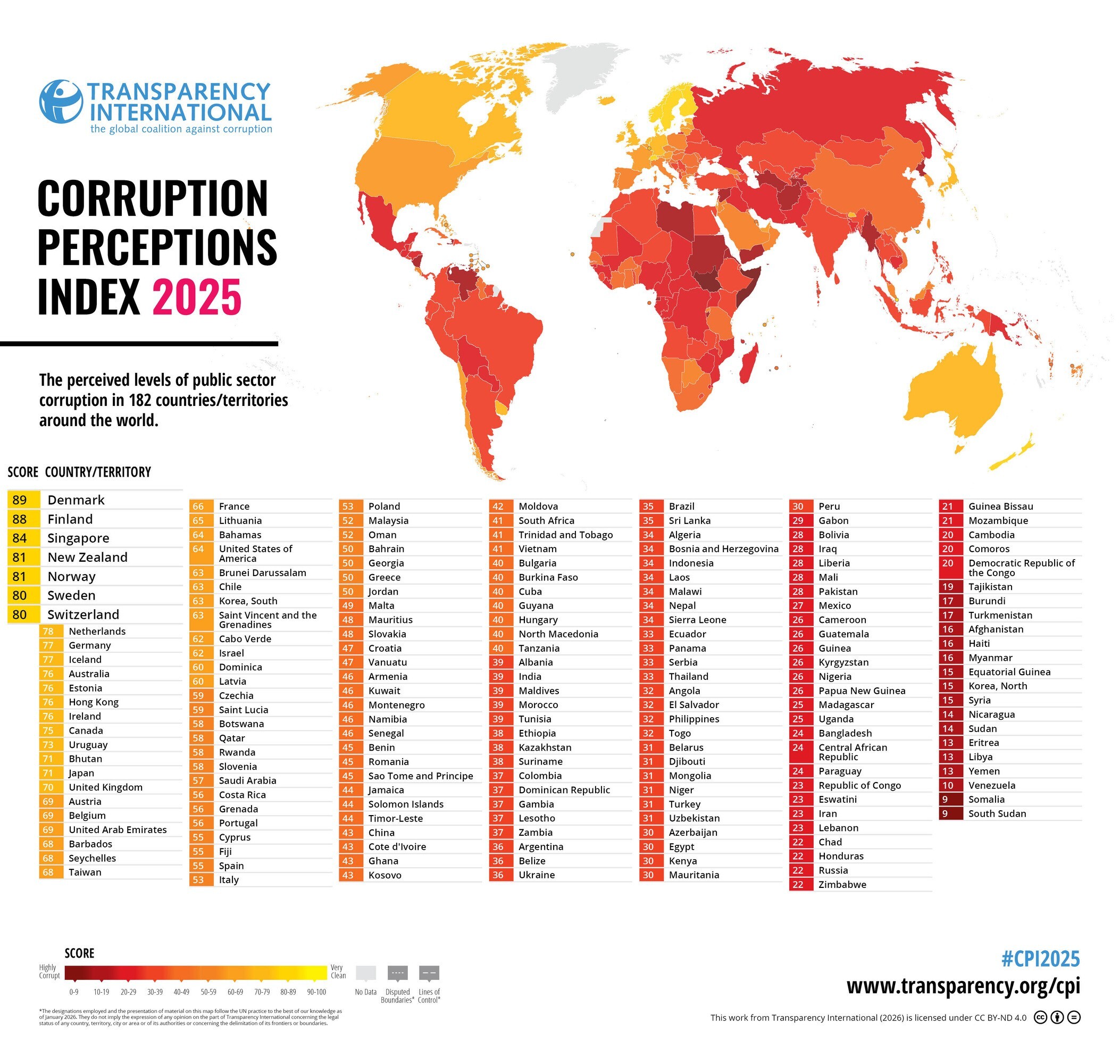
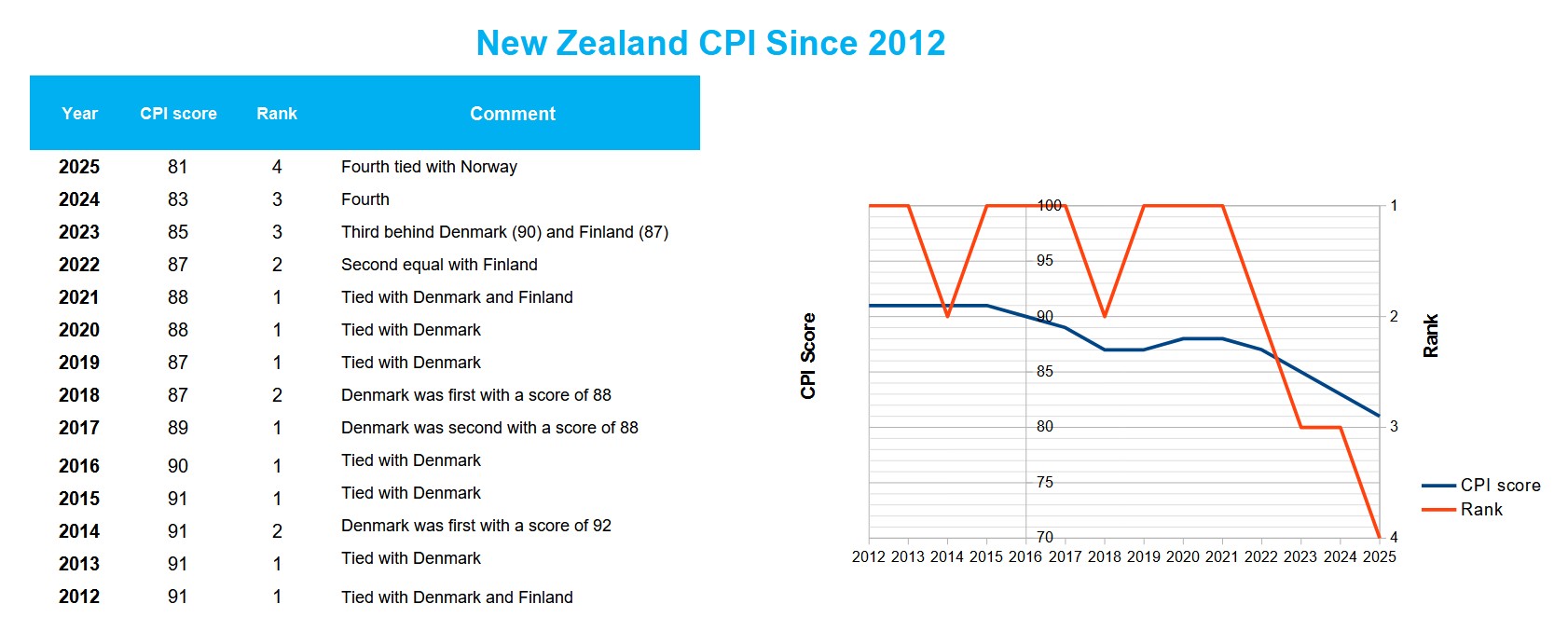
New Zealand's CPI score has fallen by two points for the fourth consecutive year—a 10% drop overall. While we still rank equal fourth with Norway, this continued slide reflects diminishing confidence among business experts and international assessors in the integrity of the public sector.
“Transparency, integrity and accountability are cornerstones of our democracy,” says Anne Tolley, Chair of TINZ. “We are seeing these values being chipped away.”
Over the past year, prosecutions involving bribery, deception, and misuse of public funds and power—including bid-rigging, cartel behaviour, driver licensing rorts and COVID-related fraud—have highlighted systemic weaknesses and a troubling disregard for both public money and integrity in general.
The just published pilot report from the Anti-Corruption Taskforce validates the expert perceptions in the CPI. It finds that internal fraud and corruption are almost certainly being under-reported and the true scale of the issue remains unclear, but what is reported in this pilot is alarming.
TINZ is also concerned by allegations affecting the integrity of voting processes in both local and national elections—issues that strike at the core of democratic trust.
“An additional major concern is the lack of transparency around lobbying and political donations,” Tolley says. “Voters have little visibility of who is influencing political decision-making. At the same time, some businesses continue to operate in the shadows, enabling money laundering and tax evasion. Investigative agencies remain hampered by reduced resources and inadequate legislative tools.”
This year’s CPI decline is driven by surveys assessing bribery and corruption risks in trade, public contracting, licensing, judicial decision-making, and the diversion of public funds for private gain.
While government agencies have strengthened some accountability measures and improved cross-agency collaboration, corruption is a broader and more complex problem. It requires cohesive action and clear strategic direction from central and local government, supported by business and civil society.”
In 2025, expert advisors informed Police Minister Costello that New Zealand remains the only Five Eyes country without a whole-of-government national anti-corruption strategy. This absence has created a significant gap in the country’s capacity to prevent, detect, and respond effectively to corruption risks in both the public and private sectors.
What Is Needed
TINZ calls for:
- A comprehensive national anti-corruption strategy
- Stronger transparency through lobbying regulation and timely disclosure of political donations
- Enhanced oversight to safeguard voting and electoral processes
“We understand that economic growth is a priority for the current Government,” Tolley says. “But a sound economy is inseparable from a robust democracy.”
“In an election year, people need to know who is driving policy change and have fair opportunities to participate in decision-making. We need real consequences for those who abuse our financial and political systems, and agencies with the leadership and capacity to reverse the troubling trends of bribery, fraud, kickbacks, and secret deals.”
ENDS
Background information for journalists
Contact
How Well Do We Counter Corruption?
In 2024 TINZ commissioned a research report to consider the concepts and measures of corruption and whether perceptions match with reality in New Zealand. This looked at changing threats, as well as progress against past assessments and sought the opinions of experts to be able to comment on the effectiveness of core anti corruption institutions.
The results of this effort produced the research report: An assessment of the effectiveness of anti-corruption institutions in New Zealand in deterring, detecting and exposing corruption. This research forms part of our National Integrity System Assessment work programme.
Background to the Corruption Perceptions Index
The Corruption Perceptions Index (CPI) is the leading global indicator of public sector corruption. It is a composite index, drawing from 13 reputable surveys/assessments, eight of which encompass New Zealand.
The index scores 180 countries and territories based on expert perceptions of corruption in the form of bribery; diversion of public funds; officials using their public office for private gain without facing consequences; the ability of governments to contain corruption in the public sector; excessive red tape; nepotistic civil service appointments; conflict of interest of public officials; legal protection for whistleblowers, state capture by narrow vested interests, and access to information on public affairs/government activities.
The process for calculating the CPI is regularly reviewed to makesure it is as robust and coherent as possible, most recently by theEuropean Commission’s Joint Research Centre in 2017.
All the CPI scores since 2012 are comparable from one year to thenext. For more information, see this article: The ABCs of the CPI: How the Corruption Perceptions Index is calculated.
About Transparency International
Transparency International is a global civil society coalitionbased in Berlin, leading the fight against corruption. It compiles anumber of measures of different aspects of corruption including theCorruption Perceptions Index, the Global Corruption Barometer, and theBribe Payers Index. Information on Transparency International can befound at www.transparency.org.
About the New Zealand chapter of Transparency International
The New Zealand chapter of Transparency International works toactively promote the highest levels of transparency, accountability,integrity and public participation in government and civil society inNew Zealand and the Pacific Islands. Find TINZ atwww.transparency.org.nz.
Transparency International New Zealand has programmes and projectsdesigned to support greater integrity. These can be viewed in our Annual Report.
Infographics