TINZ has taken a closer look at the use of urgency across the current National-led coalition (54th) parliament and the Labour (53rd) parliament. Both show a high use of urgency and a disturbing pattern of reduced time for public consultation.
This raises two main issues:
- The rule of law is being undermined by the volume of urgency used. Shorter consultation periods limit scrutiny of the Executive (those holding most power). The Executive needs evidence-based support, and challenge, by the public, the public service and politicians. This problem is reported on well in the New Zealand Law Society’s report ‘Strengthening the Rule of Law’
- If politicians pay less regard for core elements of democracy, it should be no surprise if the public lose faith in their integrity, and in democracy in general. It is also hugely wasteful of public sector resources.
What are the rules around urgency and submissions?
The default period between first and second reading of a Parliamentary Bill is six months, which enables bills to be considered by a select committee. Standing Orders 57–61 covers the use of different forms of urgency. A Minister can move a motion to apply urgency to a bill. They have to give a reason, but there is no debate, vote, or challenge to that. Urgency can lead to longer hours for debating, no stand-down periods between the stages of a bill’s progress and in the worst case, no opportunity for public consultation.
Under New Zealand's normal legislative process, the six month period between first and second reading allows the public to make submissions, and gives officials and other MPs time to analyse the evidence and responses, and then for the committee to consider and recommend changes.
The New Zealand Council for Civil Liberties (NZCCL) has advocated that the current process in the Standing Orders places too much discretionary power in the hands of the Executive and jeopardises public trust in the legislative process by allowing legislation to be passed under urgency solely on the whim of the government of the day. (NZCCL submission).
NZCCL proposes a 70% supermajority requirement to move into urgency, and a non-partisan panel or the Speaker approving urgency claims. TINZ argues that a positive test MUST be made before urgency is allowed.
How about public consultation?
The commonly cited "6 weeks for submissions" within the six-month reporting window is not actually fixed in Standing Orders – it is standard committee practice, confirmed by the Parliamentary Counsel Office's own guidance. Committees can and do set shorter or longer periods.
Under urgency, the select committee process may be omitted altogether. Where a committee is used, the public submission period can be compressed. This is happening too often, now looking like an average of 28 days with some much shorter. This substantially limits opportunities for meaningful public participation.
It’s not easy to count urgency use
Getting to the facts of urgency use would seem simple on the surface but requires considerable sifting through the reasons for urgency use and the various types. Getting the count right to look at true trends is also a challenge because:
- Financial bills proceed through urgency as a natural feature (appropriations, budget bills, secondary legislative bills), so not counted;
- Private members and local bills are quite bespoke, so best left out;
- A few bills are carry-overs, having gone through consultation from the previous parliament and agreed by the incoming government that they continue. They then move at pace, so are not counted.
What do we know?
Current Parliament (to end of June 2026) :
The National-led coalition government has applied full urgency i.e. no public consultation, moving directly from introduction of the Bill to passing of the Bill, for 20% of the relevant Bills that have been passed in this parliament up until the end of June 2026. A further 20% have suffered shortening of stages of the bill. Another 19.2% have been passed under extended hours. This comes to 92/156 or 59% of the relevant bills that have had either part or full urgency applied.
Comparison with the previous 53rd parliament
The previous government also applied urgency to a considerable level to bills going through parliament. The Labour government’s rate of bills going through with no urgency at all (30%) was lower than the current government, but its bills with full urgency at all stages was also lower, at 17%. The Labour government used other types of urgency (truncating particular stages) to a greater extent. In total all urgency including full urgency (all stages), other types (truncating stages of the bill’s progress 17%); and extended sitting (26%) mean that 70% of all relevant bills that were passed during the 53rd parliament faced some form of urgency.
What type of Bills are being pushed through with urgency?
More work is needed on this aspect of urgency but it is clear that COVID-related legislation was the main driver of full urgency use by the Labour government in the 2020-2023 term. It was also more likely to push through bills with some variations of urgency relating to Tax, Housing, Crime-response, Trade (including Russian sanctions), and Business/Consumer legislation.
The current government’s use of urgency was concentrated (but not exclusively to) its 100 day plan. Generally bills relating to Tax, Transport, Social Welfare, Business/Commerce, Housing, Resource Management and Trade are more likely to face urgency.
How does this compare with the past?
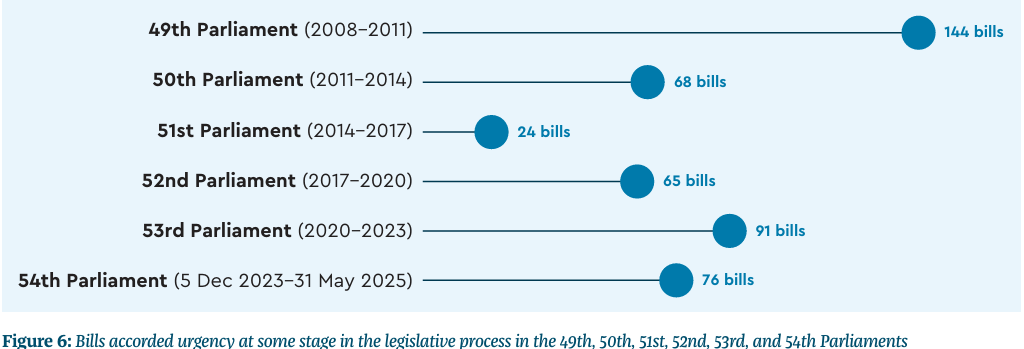
The NZ Law Society 2025 report includes the graph below showing the use of urgency at some stage in the legislative process since the 2008-2011 parliament, where urgency was used to an extraordinary extent. The use of urgency has definitely crept up over the last two parliaments.
How about public consultation?
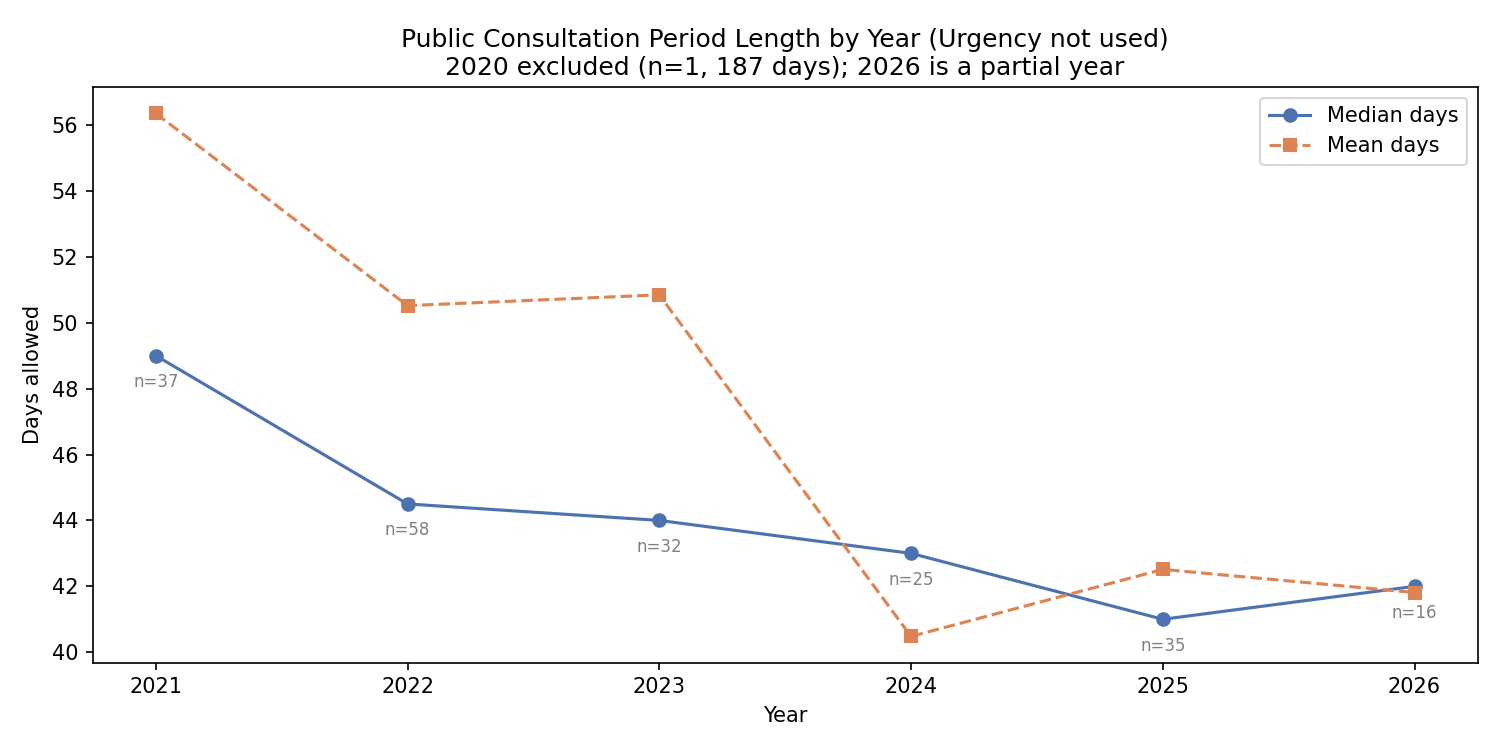
We also tracked the length of time provided for public consultation across both parliaments. This shows a reduction since 2021, now on average much shorter than the six week convention for public consultation. The situation has worsened under the current government and overall the loss is around 12 days, although there is considerable variation per bill.
Transparency International New Zealand calls on all parliamentarians to consider their role in enhancing democracy at Parliament. The beating heart of democracy is citizen participation, expressed through free, fair, and credible elections, through active public engagement and through processes that offer transparent, evidence-based scrutiny of proposed laws. These give our democratic process its legitimacy, vitality and lifeblood.