

Once each parliamentary term, Parliament's Standing Orders Committee (SOC), chaired by the Speaker and drawn from across the House, reviews the rules for how laws are made. Its September 2026 report has been published at a time when the integrity of the legislative process is under unusual scrutiny. The Committee makes recommendations for improvements but its changes would apply only from the next Parliament, and only then if the House adopts them.
The SOC report addresses, in part, several issues at the heart of representative and participatory democracy about which TINZ and other NGOs have raised concerns.
Urgency and truncated scrutiny
Submitters stated that rushed lawmaking weakens scrutiny and legislative quality, shuts out public participation and leaves people unclear why laws were passed.
The Committee accepted that urgency has risen in recent Parliaments, even though extended sittings were introduced in 2011 to curb it. It also accepted that shortened select committee report-back deadlines have become more common, often for unclear reasons.
Its recommendation sits more in transparency than restriction:
- A bill read a first time under urgency would automatically go to a select committee. Skipping that stage would need a motion in which the minister explains "with some particularity" why scrutiny should be omitted.
- Ministers seeking a report-back of less than six months would also have to give reasons.
The committee declined calls for an exceptional-circumstances threshold or mandatory debate on urgency motions.Transparency International NZ has argued for a positive test for the use of urgency with a tighter approval mechanism. This steps part way towards that, but a debate on its own won’t have much impact.
A flood of submissions
There has been a sharp increase in the number of submissions received in recent years. The graph from the report shows the number of submissions received on bills that were reported to the House during each term of Parliament since 1996. Half of the nearly 1.4 million submissions received on bills in the last 30 years were received in the current Parliament.
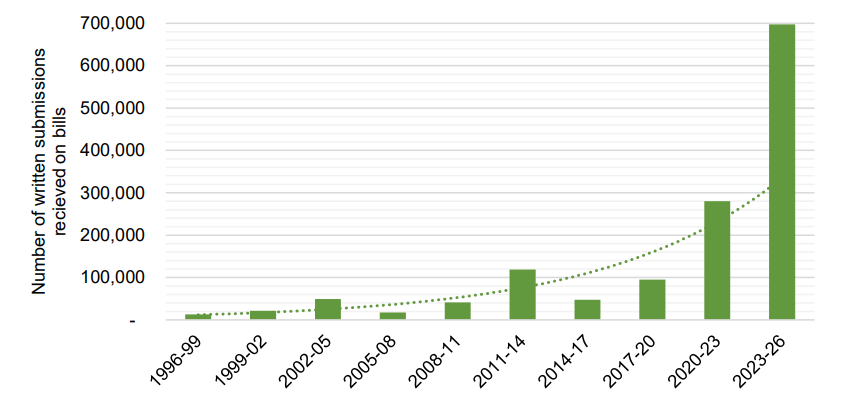
Thirty-nine bills drew more than 1,000 submissions each, against just six in 2014–17. The committee expressed concern that volumes now exceed MPs' capacity to give them meaningful consideration, and risk drowning out thoughtful input.
The recommendation from the Standing Orders Committee is a new purpose statement. A select committee's primary purpose would be producing high-quality legislation. Being informed of public views, as far as practicable, would be secondary.
On oral hearings, committees are told:
- They need not hear everyone who asks - the submissions process is not a straw poll.
- They should prioritise submitters offering specific expertise or lived experience.
- They should explain publicly any criteria used to choose who is heard.
- Experts may be given longer slots.
This deprioritisation of public views as a general principle rings an alarm bell for TINZ as a civil society group. The risk is of course that consultation becomes more elitist and ordinary citizens take a back seat, or no seat at all. Public consultation should be encouraged.
The last two parliaments have generated more public consultation due to the impact of COVID emergency legislation in the 53rd term, and the coalition agreement affecting labour rights, natural resources and Te Tiriti in the 54th term.
A mandatory minimum submission period was rejected by the Committee. The long-standing six-week guideline is instead restated as a strong expectation.
Strong expectations ‘don’t butter no parsnips’. That six-week guideline is already in place and has been rarely applied in the current term of Parliament with (from TINZ’s analysis) an overall reduction of 10-12 days for public consultation.
AI and independent advice
In response to increasing volume the Committee and the Public Service Commission are expecting departments to outsource submission summaries, and to use AI to summarise them. The Committee insists that AI must support, not replace, people reading submissions. That stops short of the binding audit and transparency safeguards the Law Society sought.
The Committee also acknowledged a potential conflict when officials summarise submissions on their own Minister's bill. It warned that failing to convey submissions in good faith could be treated as contempt. The Committee stated that a minister's policy preferences may be shared openly, but committees should avoid any perception that they take instructions from the government. Greater use of independent advisers is encouraged, though this is without new funding.
A Legislative Scrutiny Committee
A major recommendation by the Committee is a new specialist committee, chaired by the Deputy Speaker and without a government majority with the aim of taking on bills that are less controversial. It would:
- consider less controversial bills
- question ministers in public "consideration in detail" sessions in place of the committee of the whole House
- report on the legislative quality of bills before other committees
Revision bills, which can now change the law substantively, would pass through it twice. Omnibus rules are relaxed only for minor amendments. The committee warned that wider loosening would shift power to ministers.
Financial scrutiny
The report builds on the 2023 reforms: dedicated scrutiny weeks, longer in-depth annual reviews, and expectations that ministers and chief executives front up. It does so mainly through further guidance on how these should operate. The Parliamentary Commissioner for the Environment welcomed scrutiny weeks but cautioned that they reinforce a siloed, agency-by-agency view of spending, and urged a focus on outcomes.
What's missing that TINZ and other organisations have recommended:
- no post-legislative review of laws passed under urgency
- no formal Bill of Rights process for late amendments
- no limits on substantive Amendment Papers
- no oversight of general behaviour such as wholesale shortening of public consultation periods.
Whether the report strengthens democratic scrutiny will depend less on the rule changes than on whether governments and committees honour the expectations it sets.


